
Germantown Previous Residents Sources
No single record names every person tied to an address. Washington County land records prove ownership. Published directories and census schedules reveal who actually lived in a Germantown home. The parcel card comes first. It supplies the tax key, situs address, mailing address, and legal description that keep the search locked to the right land. From there, each era offers different records, and each record has limits. The table below maps what each source can prove and where access may stop.
| Source | Years It Covers | Where Held | What It Shows |
|---|---|---|---|
| County land records | Mid-1800s to present described by the office; online cutoff unverified | LandShark and Register of Deeds | Deeds, liens, plats, transfers, and legal descriptions |
| Tax parcel and GIS | Current database; historic depth not stated | Ascent and WashCoGIS | Owner, situs and mailing addresses, tax key, geometry |
| County directories | Johnson 1969-1992; Polk 1995-2010 | West Bend Community Library finding aid | Name and address continuity; reverse sections need confirmation |
| Federal and state census | Federal schedules through 1950; Wisconsin schedules through 1905 | NARA, WHS, and research libraries | Households, ages, ties, and some street addresses |
| Village property files | Current archive confirmed; start year not found | Village Building Inspection | Permit dates, owner or contractor, project, parcel ID |
| Historic plat and archives | 1915 plat; archive years vary | Library of Congress and Tower Heritage | Landowners, roads, maps, photos, newspapers, probate |
Match the source to the era. Recent transfers start with Ascent and LandShark. Late twentieth-century lookups lean on the dated county directory runs. Earlier decades call for census schedules, land books, church and cemetery records, plats, and archives. A blank result never proves a house stood empty. It can signal a missing directory year, a deed kept office-only, a redrawn parcel, or a name indexed under a different spelling.
Anchor the Germantown Parcel
Begin at the Washington County real-estate parcel search. The tax filters take one term at a time. Try a last name. Or try a street number paired with a street name. Less text usually works better. Watch directional words too, since Washington and East Washington are different searches in the system.
Copy down the situs address. Add the owner name, mailing address, parcel or tax key, legal description, subdivision, lot, and block. Situs is the physical site of the taxable parcel. Mailing is where the tax notice travels, which may be far away. Keep both, and never assume the owner lives in the house. An address format can shift. A parcel can split too. When that happens, the legal description is the strongest link a Germantown researcher can hold.
Trace Germantown Owners Backward
The Washington County LandShark index turns that parcel anchor into a chain of title. Search the current owner as grantee. That is the party receiving title. Before trusting a deed, compare its legal description and recording date against the parcel card. Mortgages, satisfactions, releases, and liens can all carry a name without moving ownership an inch.
- Pull the current owner, tax key, and legal description from the parcel card.
- Find the deed by which that owner acquired the same land.
- Read the seller, or grantor, then search that party as a prior grantee.
- Repeat for each transfer, checking every trust, estate, company, and co-owner name.
- When the online trail ends, contact the Register of Deeds for office books and older records.
- Grantor and grantee
- The grantor gives or sells an interest. The grantee receives it.
- Chain of title
- The ordered series of recorded transfers for the same land.
- Legal description
- The lot, block, plat, or measured boundary that identifies land more reliably than an old street label.
The official LandShark access screen is the county recorder route for the deed side of an address history.
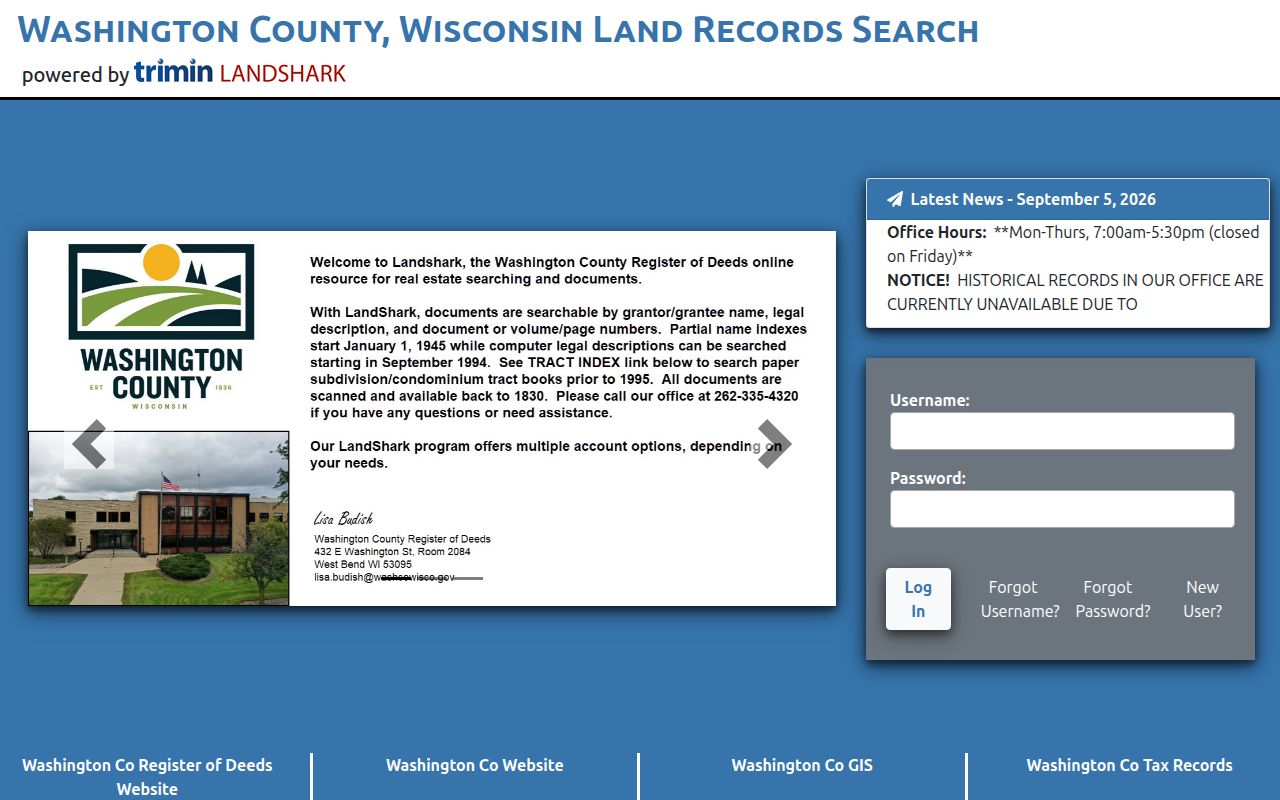
The landing screen is only a doorway. A sound chain still hinges on matching every indexed name to a parcel. It must also match the same legal description.
Maintain a chain table listing year, instrument number, grantor, and grantee. Add legal description, tax key, plat reference, source, and confidence. Mark a gap plainly rather than guessing at a link. Name searching in LandShark is free. Images and printing carry fees. The office traces land history back to the mid-1800s. It publishes no exact online cutoff for the records.
Germantown Deeds Beyond LandShark
The Washington County Register of Deeds sits at 432 E Washington Street, Room 2084, in West Bend. Posted hours run Monday through Thursday, 7:00 a.m. to 5:30 p.m. The office is closed Friday. Historical research is set aside for Tuesday through Thursday, 8:00 a.m. to 4:00 p.m. Appointments are encouraged. A call to 262-335-4320 before any trip saves trouble.
Current access note. Construction has made paper historical books temporarily unavailable, so confirm access before planning an office visit.
Research inside the office follows house rules. Sign in, leave cameras and cell phones behind, and get prior approval before bringing a laptop. Older deeds can sit in books even when the web search returns nothing. Note the book and page, instrument number, exact spelling, and legal description. That way any step can be rechecked later.
The Register of Deeds page and notice carries the current hours, fees, and status of historical access.
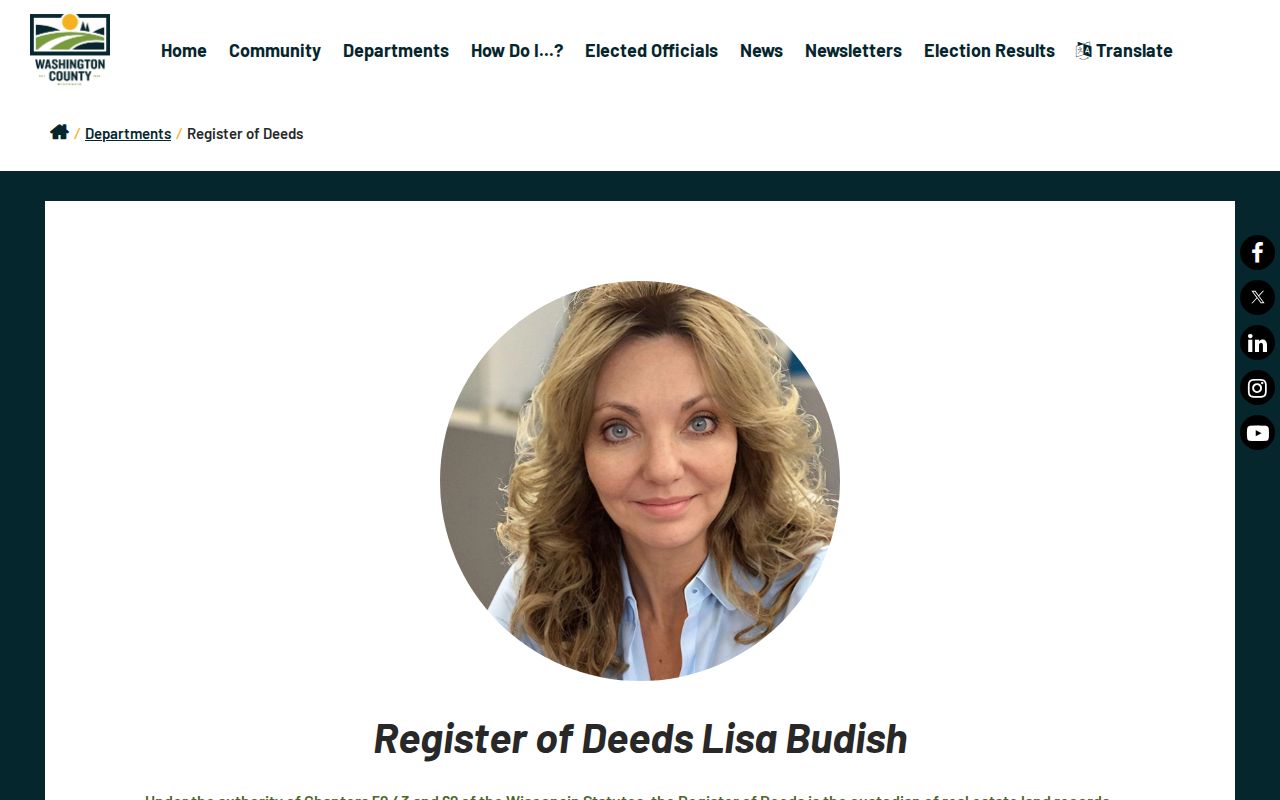
When a LandShark search stops short of an older book, or a certified copy is required, the office page is the fallback.
Pair Germantown Directory Years
Ownership answers only half the question of who lived in a Germantown home before. A resident may have rented. Some stayed with relatives or occupied a building titled to a trust. The West Bend Community Library's finding aid documents directory runs. Its Washington County holdings span Johnson Publishing editions from 1969 through 1992. R. L. Polk editions run from 1995 through 2010. Confirm the volumes are still on the shelf. Ask whether a given edition includes a reverse street section. That can speed the hunt considerably.
- Choose a deed, permit, obituary, or known event as the anchor year.
- Find each surname in the nearest directory edition and copy the printed address exactly.
- Check a reverse or criss-cross section, if present, for the address and nearby entries.
- Compare the nearest public census year for names, ages, and household ties.
- Repeat before and after the anchor year, noting missing editions without treating them as absence.
Federal census schedules naming individuals are public through 1950. Wisconsin's own schedules run scattered from 1836 to 1905. The 1905 count names every household member. Most early state rolls list only the head of household. The 1890 federal census is largely lost. Most Wisconsin records from 1865 did not survive. Those gaps make a dated directory entry valuable. Yet it still needs a second record to stand on.
Keep Germantown Land in View
Land records often outlast the street names attached to them. A Germantown deed may switch to a new subdivision name, a certified survey map, a lot number, or a metes-and-bounds description. Follow that wording through every transfer. The land itself stays put. WashCoGIS helps you do it. The county viewer carries parcel, address, plat, road, zoning, and imagery layers. It also offers geocoders for both current and retired tax keys. There is no Germantown-wide renumbering project on record. So bridge any address mismatch with evidence instead of assuming a renaming. For older landowner and road context, the Library of Congress holds a digitized 1915 plat of Washington and Ozaukee counties. Village property files can add permit dates, work descriptions, parcel IDs, owners or contractors, and inspection events. The village publishes no web index of them. Treat a permit date carefully. It marks work on a structure, not a deed transfer or a move-in.
Tower Heritage House Research
Some Germantown trails dead-end on public portals. Tower Heritage Center in West Bend steps in. Its archive holds property and family files, tax records, community directories, newspapers, obituaries, probate material, church and cemetery sources, maps, and more than 17,000 photographs across about 800 cubic feet of records.
The reading room is free Mondays and Tuesdays, 2:00 to 4:00 p.m. A one-hour self-guided visit costs $15. A comprehensive property report costs $95 and adds historic maps, photographs, and newspaper material. Collection years differ by item. Call 262-335-4678 or consult the Tower Heritage archive service page before a visit. Sanborn fire-insurance maps show footprints, materials, and additions. Tower lists Sanborn material. No Germantown-specific edition or year is confirmed there, so use a map only when its title and coverage truly include the address.
Before Germantown State Records
Germantown's paper trail starts early. Freistadt was founded by German immigrants in 1839. St. John's congregation dates to 1843. Wisconsin began requiring county vital registration in 1852, though compliance stayed uneven for decades.
Church registers, cemetery sources, deeds, and plats can identify a family before any state vital index does. Older records may instead say Town 9, South Germantown, Dheinsville, Freistadt, or Rockfield. Search the printed surname first. Then try careful spelling variants, including anglicized forms. A spelling pattern is a lead, not proof, so match the person to a spouse, church, cemetery, tract, census household, or deed before counting them among a property's past residents.
Confirm Germantown Past Residents
Confirming past residents takes corroboration. Obituaries may give a former address, spouse, church, cemetery, and relatives. Washington County probate files can hold heirs, addresses, attorneys, inventories, and closing papers. Probate records are generally open, but guardianship and civil commitment files stay confidential. The probate search fee is $4. Copies run $1 per page. Tower Heritage, church custodians, funeral-home archives, the Wisconsin Historical Society, and the Germantown Community Library offer other ways to close the trail.
Cite the exact edition, schedule, deed, file, or notice. Never infer a present address from an old obituary. The Germantown city directory page goes deeper. Paired with dates and land evidence, those county directory records can separate a titled owner from the past residents who actually occupied the property.
Lawful use. Germantown house research belongs in family history, property history, and personal inquiry. Never use a historic trail to track, harass, or harm a living person.