
Verified Germantown Directory Collections
The strongest documented city directory spine comes from a September 30, 2011 inspection of the West Bend Community Library reference collection. It records two Washington County publisher runs. Current shelf completeness must still be checked, and the Germantown catalog does not expose a static item inventory.
| Collection | Years | Where Held | Access |
|---|---|---|---|
| Johnson Publishing county directories | 1969–1992 | West Bend Community Library finding aid | Confirm shelf and editions |
| R. L. Polk county directories | 1995–2010 | West Bend Community Library finding aid | Confirm shelf and editions |
| Regional History and Genealogy Center | Exact runs not exposed | Germantown Community Library | Catalog and reference desk |
| Washington/Ozaukee plat | 1915 | Library of Congress | Free digital image |
No official source established the first Germantown-specific directory, the last printed year, a full publisher history, or exact reverse-directory runs. Do not assume annual publication. Ask for a volume by publisher and year, then inspect its title page and contents.
Always record the volume title, publisher, year, page, and exact printed spelling. Those details let another researcher repeat the Germantown city directory search and test the result against deeds, census schedules, or church records.
Start at Germantown's History Center
The Germantown Regional History and Genealogy Center catalog needs JavaScript, so its static page did not reveal exact directory, newspaper, obituary, yearbook, or database holdings. Search the catalog, then ask the reference desk to confirm an item before travel.
A 2017 annual report confirms internet access, scanning, copying, a microfilm and microfiche reader, and reference help. Those channels matter for city directories and newspapers with no open web index. Bring the person's name and variants, likely year, street, church, employer, and publisher.
The local-history catalog entrance is shown below.
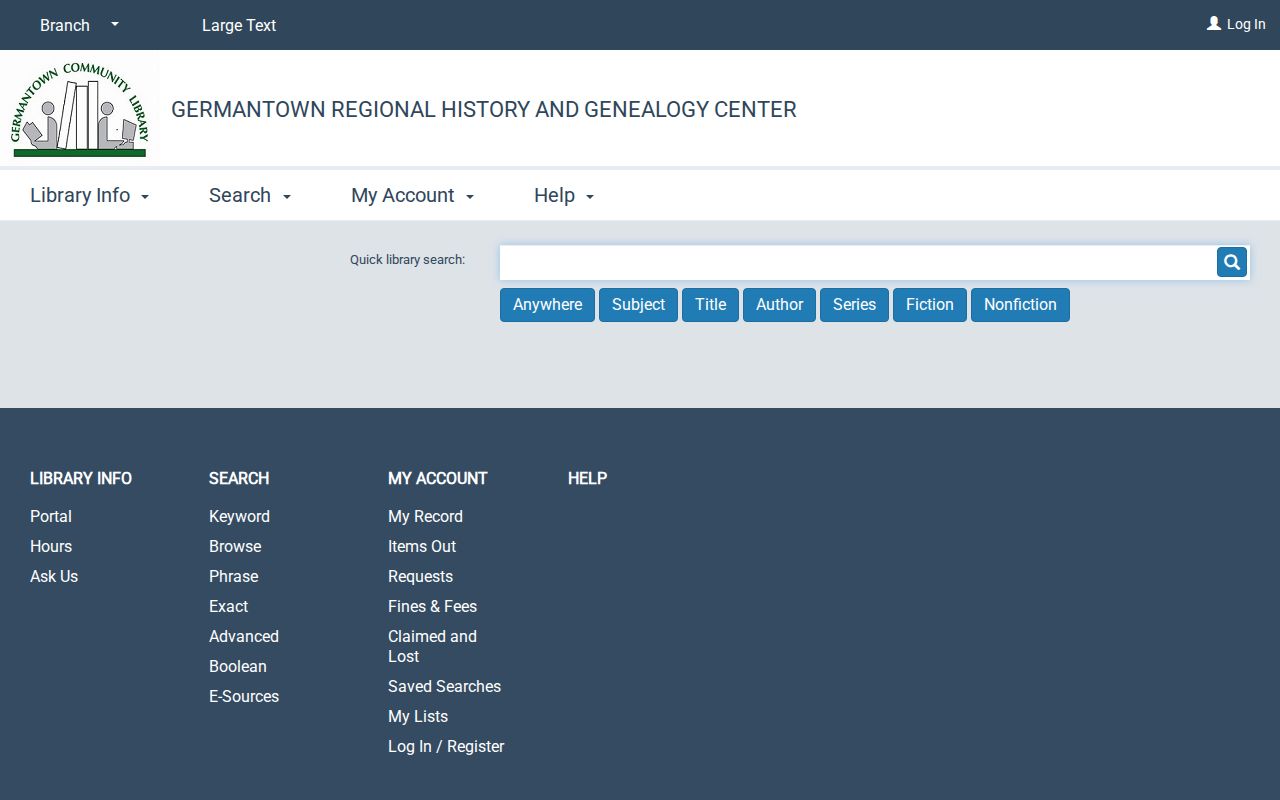
The catalog is a finding route, not proof that a specific edition or reverse section is available.
Read a Germantown Directory Entry
Begin with the alphabetic listing and copy it exactly. A line may include surname, initials, spouse, work, employer, residence, or business address. Symbols vary by publisher and year, so read that edition's key before expanding shorthand.
| Identity | Surname, given name, initials, and spouse or relative when printed |
|---|---|
| Work | Occupation, employer, and a possible business listing |
| Place | Residence or business address, unit, and street form |
| Status | Owner or resident mark only when the edition defines it |
| Family clue | Widow or widower notation and linked household names |
- Criss-cross directory
- A street-order section that moves from an address to a printed occupant or business.
- Householder index
- A list centered on household heads or principal names, not every person present.
- Abbreviation key
- The publisher's legend for residence, work, family, business, and status marks.
Follow the address as well as the surname. A format change may not mean a move. Compare spouse, work, adjacent entries, and the next edition. No personal Germantown entry image was retrieved, so no unverified symbol should be given a fixed meaning.
Reverse Germantown Directory Searches
A reverse or criss-cross section is the historical address tool. Find the street, then the house number, and transcribe every printed name or business. The Johnson and Polk runs are verified, but the finding aid does not say which volumes contain reverse pages.
If none appears, find a known person alphabetically, take the address, and compare it across nearby years. A blank year does not prove absence. The publisher may have missed the household, covered a different area, or filed the entry under a spouse, relative, business, hamlet, or variant.
Modern parcel work belongs in the Germantown street directory. A historical volume answers only what its publisher printed then.
Pair Germantown Directories With Census
The Wisconsin Historical Society family collections hold state and territorial census material from 1836 through 1905, pre-1907 vital indexes, and a name index. Most censuses through 1895 name only the household head. The 1905 census names all members.
Federal schedules are public through 1950 under the 72-year rule. Depending on the year, they add age, birthplace, relationship, work, and street details that a city directory omits. The 1890 census is largely lost. Most of Wisconsin's 1865 census also failed to survive, and Washington County is not among the six surviving counties named by WHS.
These gaps make directories useful between census years, but not a substitute for relationships. Cite every source and date.
Place Germantown Names on 1915 Land
The 1915 Washington and Ozaukee plat from North West Publishing and Albert Volk connects landowners and patrons with township roads and place names. It is a historical map, not a current household list.
Start with a surname or land clue, then locate its township setting. Compare it with a deed's section, township, and range, not just a modern street. Records may use Town 9, South Germantown, Dheinsville, Freistadt, Rockfield, or another hamlet. Save the plat page and date beside the directory citation.
No successful plat screenshot was captured. Use the linked Library of Congress image directly, then validate a transfer through LandShark or the Register of Deeds.
Extend Germantown Leads at Tower
Tower Heritage Center in West Bend links directories to newspapers, probate, obituaries, cemetery and church records, taxes, property reports, maps, and business files. Its description lists more than 17,000 photographs and 800 cubic feet of records.
The reading room is listed as free Mondays and Tuesdays from 2 to 4 p.m. The page also lists a one-hour self-guided visit at $15 and a comprehensive property report at $95. Confirm hours and prices. Call 262-335-4678 when a city directory, obituary, or property file is not online.
Review the archive services shown below.
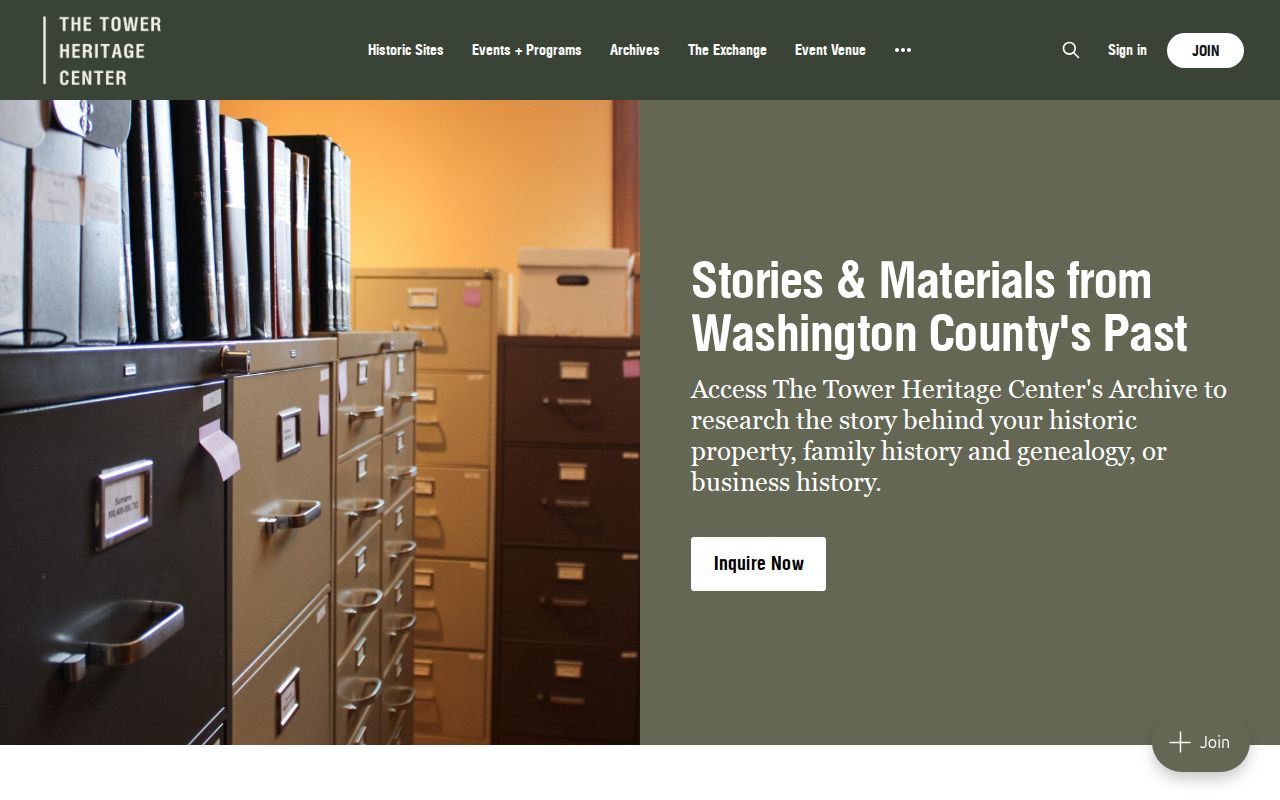
The archive can test one directory clue against several source types without turning it into unsupported proof.
Germantown Records Before Directories
Freistadt was founded by German immigrants in 1839. St. John's official history describes a congregation dating to 1843. These institutions predate regular state vital registration. Wisconsin required registration in 1852, but enforcement stayed uneven until about 1880. DHS reports Washington County dates as early as 1846 for marriage, 1859 for birth, and 1873 for death.
An early family may first appear in a church register, cemetery, deed, plat, naturalization file, or census. German spellings, umlauts, short given names, and later anglicized forms are sound variants to test. They do not prove identity.
Use the St. John history and Germantown Historical Society as local leads. No Village-wide cemetery index was verified, so contact the custodian.
Germantown Directory Research Timeline
The record trail shifts with publication and boundaries. These dates describe separate sources, not a seamless city directory series.
| 1836 | Village history begins with Town 9 in Wisconsin Territory. |
|---|---|
| 1839 | Freistadt settlement adds an early place-name key. |
| 1843 | St. John supplies a church and cemetery lead. |
| 1915 | The Washington/Ozaukee plat maps owners and patrons. |
| 1969–1992 | Verified Johnson Publishing directory run. |
| 1995–2010 | Verified R. L. Polk directory run. |
Official local sources disagree on one incorporation date. A detailed narrative says South Germantown became a village in 1927 and the Town and Village merged in 1964. Preserve the source attached to each date.
Request Germantown Directory Help
When the catalog does not show an edition, use the access channels in order. Search Polaris for the publisher and year, call or visit the Germantown reference desk, ask West Bend Community Library to confirm the old finding aid, then contact Tower Heritage for county directory, newspaper, probate, cemetery, or property material. The Wisconsin Historical Society search and an Area Research Center can extend a name or place search into state records.
Give the librarian a focused request: full name and variants, approximate dates, known street or hamlet, spouse, church, employer, and the Johnson or Polk span being tested. Ask whether the item is a bound book, microfilm, microfiche, or licensed database, whether it has reverse pages, and what copying rules apply. The library's older annual report supports scanning, copying, microform reading, and staff help, but current availability must be confirmed.
No official static source verified a complete Germantown obituary index, newspaper-year list, yearbook run, or licensed directory database. State that limit plainly. A reference-desk answer can fill the gap, while an unsupported web claim cannot.
Trace Families in Germantown Directories
Anchor the search with one reliable year from a deed, census, obituary, parcel card, or family record. Then move through the city directories on both sides of that date. Preserve exact spellings and address forms before testing variants.
- Search surname and first-name variants in the closest edition. Copy address, spouse, work, employer, and status wording.
- Check the reverse section when present. Copy each name at the address and note units or business lines.
- Repeat in the nearest earlier and later volumes. Keep blank years as gaps, not proof of a move.
- Pair the directory with a census. Use census relationships to test, not assume, the household connection.
- Close the trail with deeds, probate, obituaries, church or cemetery records, and the archive holding them.
A disappearance can mean a move, death, missed canvass, changed publication area, variant spelling, or an entry under another member. Test each with dated evidence. Probate and obituary records can reconnect a family line while respecting confidential divisions.
Note: A directory entry is a dated publication clue, not proof that the named person still occupies the address.